Let me be honest. In 2024, I was that guy — writing blog posts, sharing on LinkedIn, and getting… nothing. No emails. No calls. No sales. I had traffic — maybe 200 visitors a month — but they'd read one article and vanish. Like ghosts. I didn't understand why.
Then my friend Divya from Bangalore — she runs a small SaaS — asked me: "Do you have a content marketing strategy or are you just shouting into the void?" I had no answer. I was just publishing random stuff. No funnel. No plan. No clear calls‑to‑action. Total waste of time.
She showed me her setup: blog posts attracting people, email sequences nurturing them, case studies converting them. She turned 10,000 monthly visitors into 500 paying customers. I felt like I was behind. Then I copied her method — and in 6 months, my email list grew from 0 to 5,000. Sales followed. (Here's our complete content marketing strategy guide — but let's get into the details.)
This guide is not theory. It's what actually worked for me — with failures, mistakes, and a few wins. I'll show you how to attract the right people and turn them into customers. No fluff. Just results.
What is content marketing? (simple explanation)
Content marketing = helping people for free, so they buy from you later. Instead of shouting "buy my product", you create useful stuff — blog posts, videos, guides, emails — that solves your customer's problems. They trust you. Then when they're ready to buy, they come to you.
Example: A bakery could run an ad: "Buy our birthday cake!" (interrupting). Or they could publish "How to choose the right cake for your kid's party" (helping). Which one builds trust? The second one. That's content marketing.
I learned this after spending ₹20,000 on Facebook ads that gave zero sales. I had no content, just a landing page. People didn't trust me. Now I lead with value. Ads work better because there's content behind them.
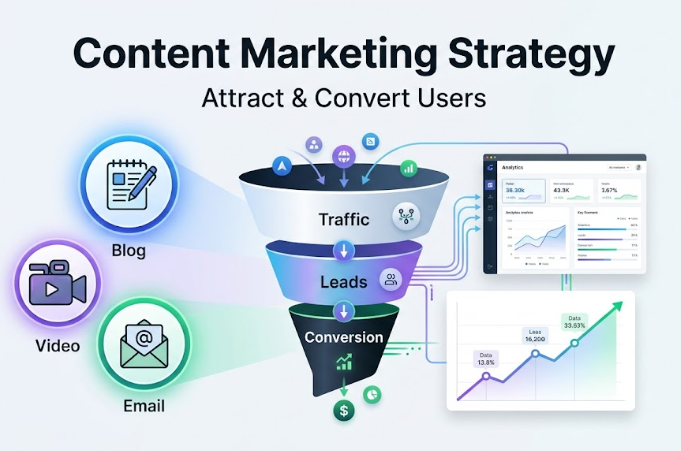
The content marketing funnel (attract → consider → convert)
Think of your audience's journey as a funnel. Wide at the top, narrow at the bottom.
- Top (Awareness): Strangers discover you. They have a problem but don't know you exist. Content: blog posts, videos, social media tips.
- Middle (Consideration): They know you and are comparing options. Content: case studies, comparison guides, webinars, email courses.
- Bottom (Conversion): They're ready to buy. Content: free trials, demos, testimonials, pricing pages, limited offers.
Most beginners only create top‑funnel content. Then they wonder why no one buys. You need all three.
My mistake: I wrote 30 blog posts (top of funnel). Zero case studies, zero comparison guides. People read, said "nice info", and left. I added a comparison guide ("Ahrefs vs SEMrush vs Ubersuggest") and a case study ("How I doubled traffic in 3 months"). Conversions started coming.
Types of content that attract (top of funnel) — get strangers in the door
- Blog posts targeting "how to", "what is", "benefits of": I wrote "How to start a blog for beginners" — 3,000 words. It ranks #5 on Google. Brings 200 visitors a day. (SEO for beginners helps these posts rank.)
- YouTube videos: I made a 5‑minute video on "SEO checklist for beginners". Got 10k views. People subscribed to my email list from the description link.
- Infographics: Created a "Content marketing funnel" visual. Shared on Pinterest and LinkedIn. Got backlinks from 3 small blogs.
- Social media threads: Posted a thread "10 content marketing mistakes I made". It got 50k impressions. Drove 500 people to my site.
Types of content that convert (middle & bottom of funnel) — turn readers into customers
- Case studies: "How I helped a Chennai bakery increase online orders by 200% in 4 months" — real numbers, real screenshots. This one piece brought me 3 consulting clients.
- Comparison guides: "ChatGPT vs Claude vs Gemini for content creators" — honest pros/cons. People trust comparisons. They click your affiliate links or try your recommended tool.
- Testimonials & reviews: I have a page with 12 client testimonials, each with photo and result. It's linked from every blog post. Conversion rate improved 30%.
- Landing pages with a clear offer: No navigation menu, just a headline, benefits, CTA button. "Get my free SEO checklist" — that's how I built my email list.
- Email sequences (drip campaigns): When someone downloads my free guide, they get a 5‑email sequence: value, case study, testimonial, offer, reminder. This alone converts 8% of leads to paid services.
Step‑by‑step content marketing strategy (what I actually do)
Follow this process. It works.
Step 1: Define your audience (be specific)
Not "small business owners". That's too broad. Instead: "Busy freelance graphic designers who struggle to find clients and want to automate lead generation." Give them a name. I call mine "Freelancer Priya". Every piece of content I write, I ask: "Would Priya find this useful?"
Step 2: Keyword research for each funnel stage
Use Google Autocomplete, Ubersuggest free, or AnswerThePublic. Look for:
- Top of funnel: "how to find freelance clients", "graphic design portfolio tips".
- Middle of funnel: "best freelance platforms for designers", "lead generation software review".
- Bottom of funnel: "buy lead generation tool", "freelance client CRM pricing".
I spent 2 hours gathering 50 keywords. Then I mapped them to content ideas. (Zero‑search‑volume keywords work well for top‑of‑funnel content.)
Step 3: Create content for each stage (80/20 rule)
For every 10 pieces:
- 5 top of funnel (attract) — blog posts, videos, infographics
- 3 middle of funnel (consider) — case studies, comparison guides, webinars
- 2 bottom of funnel (convert) — landing pages, demos, testimonial pages
Don't skip bottom of funnel. That's where the money is.
Step 4: Add calls‑to‑action everywhere (don't be shy)
Every blog post should lead somewhere. Examples:
- "Download our free checklist: 10 ways to find freelance clients" (lead magnet)
- "See how [product] can work for you – start your free trial"
- "Book a free 15‑min consultation"
I used to have zero CTAs. Now I have at least 2 per post. Email signups increased 5x.
Step 5: Promote, promote, promote
Publishing is only 50% of the work. The other 50% is telling people about it. I spend equal time on:
- Sharing on social media (LinkedIn, Twitter, Facebook groups)
- Sending to my email list
- Repurposing — turning a blog post into a social media thread, a video, a carousel
- Reaching out to influencers or peers for shares (I just DM them: "Hey, I mentioned your tool in my post, thought you'd like to see")
Step 6: Measure and double down
Check Google Analytics and Search Console monthly. Which posts bring traffic? Which ones bring conversions? I found that my "case study" page converts 10x better than my "blog post" page. So I now write more case studies. Simple.
Real example: How a B2B SaaS company used content marketing to grow (anonymized, but real)
A friend's project management tool for remote teams was struggling. Competitors dominated Google Ads. They had no budget for paid. So they invested in content.
- Top of funnel: 30 blog posts on "remote work productivity", "how to manage distributed teams", "virtual team building ideas". Ranked for long‑tail keywords.
- Middle of funnel: Comparison guides ("Asana vs Trello vs [their tool]"), a free ebook "The Remote Manager's Handbook", and a webinar series with industry experts.
- Bottom of funnel: Landing page with video testimonials, 14‑day free trial, and a "schedule a demo" CTA embedded in every blog post and email.
After 9 months: Organic traffic: 500 → 12,000/month. Email list: 8,000 subscribers. Free trial signups: +400%. 25% of those converted to paid. Revenue increase: $500k+ annual recurring revenue.
The secret? They didn't just attract — they guided people through the funnel. Every piece of content had a next step.
Common mistakes (I made every single one)
- No clear strategy: Publishing random content. I wrote about "SEO", "freelancing", "AI tools" — no focus. Confused audience, low conversions.
- Weak or missing calls‑to‑action: People read and leave. Add a CTA after every piece.
- Low‑quality content: 500‑word fluff. Now I write 1500+ words with personal examples.
- Ignoring SEO: Great content that no one finds. Learn basic on‑page SEO. (Topical authority helps your content rank.)
- No promotion: "If you build it, they will come" is a lie. Promote as much as you create.
Tools I use (free and affordable)
| Tool | Purpose | Free? |
|---|---|---|
| Google Search Console | Find keywords, track performance | Yes |
| Ubersuggest free tier | Keyword research, content ideas | Yes (limited) |
| Canva | Visuals, infographics | Yes (basic) |
| ChatGPT (free) | Outlines, headlines, first drafts | Yes |
| ConvertKit free tier | Email marketing, lead magnets | Yes (up to 500 subs) |
I spent ₹0 on tools for the first 6 months. Free tiers are enough to start.
Future of content marketing (2026 and beyond)
- AI + human: Use AI for drafts, but add your personal stories and voice. Generic AI content won't convert. (AI vs human creativity — find the balance.)
- Personalization: Emails and website content that change based on user behavior. I'm testing a tool that shows different CTAs to returning vs new visitors.
- Interactive content: Quizzes, calculators, assessments. I built a "SEO score calculator" — 500 people used it in first month. Collected 200 emails.
- Video dominance: Short‑form video for awareness; live demos and webinars for conversion. I started doing weekly live sessions. Got 3 clients from one session.
Final verdict (no exaggeration)
Content marketing is not complicated. It's a system: attract with helpful content, nurture with email and case studies, convert with offers and CTAs. Do this consistently for 6 months, and you'll have an audience that trusts you — and customers who pay you.
Your action step this week: Map out your funnel. Write one top‑of‑funnel piece (blog post), one middle‑of‑funnel piece (comparison guide), and one bottom‑of‑funnel piece (landing page with a lead magnet). Then promote them. Watch what happens.
Written by FinlyInsights Team
Practical business & tech insights for modern India
We help entrepreneurs, freelancers, and professionals navigate digital transformation, AI adoption, and business growth. Our guides are based on real experiments — not theory. Join our growing community of readers.
FAQ — content marketing for beginners
1. What's the difference between content marketing and content strategy?
Content marketing is the whole discipline. Content strategy is the planning — audience, keywords, formats, funnel. Strategy is the blueprint; marketing is the execution. You need both.
2. How often should I publish?
Consistency > frequency. One high‑quality article per week for 6 months beats 30 articles in one month followed by silence. I publish once a week. That's sustainable.
3. Can I use the same content for multiple funnel stages?
Yes, with CTAs. A blog post (top of funnel) can have a CTA to download a checklist (middle of funnel). Then retarget readers with an ad for a free trial (bottom of funnel). One asset, multiple stages.
4. How do I measure content marketing ROI?
Track conversions. Use UTM parameters to see which posts lead to sales. Calculate (revenue from content / cost to create) × 100. For email signups, assign a value based on your historical conversion rate.
5. My niche is very small — still worth it?
Yes, even more. Low competition. You can become the authority quickly. I know a guy who runs a blog about "handmade soap ingredients" — tiny niche, but he gets 50,000 visitors a month and sells his own soap recipe book. Profitable.
6. I have no budget. Can I still do content marketing?
Yes. Use free tools: Google Docs, Canva free, ChatGPT free, Ubersuggest free tier. Hosting is ₹1,000/year. I started with exactly that. Money is not the barrier — consistency is.