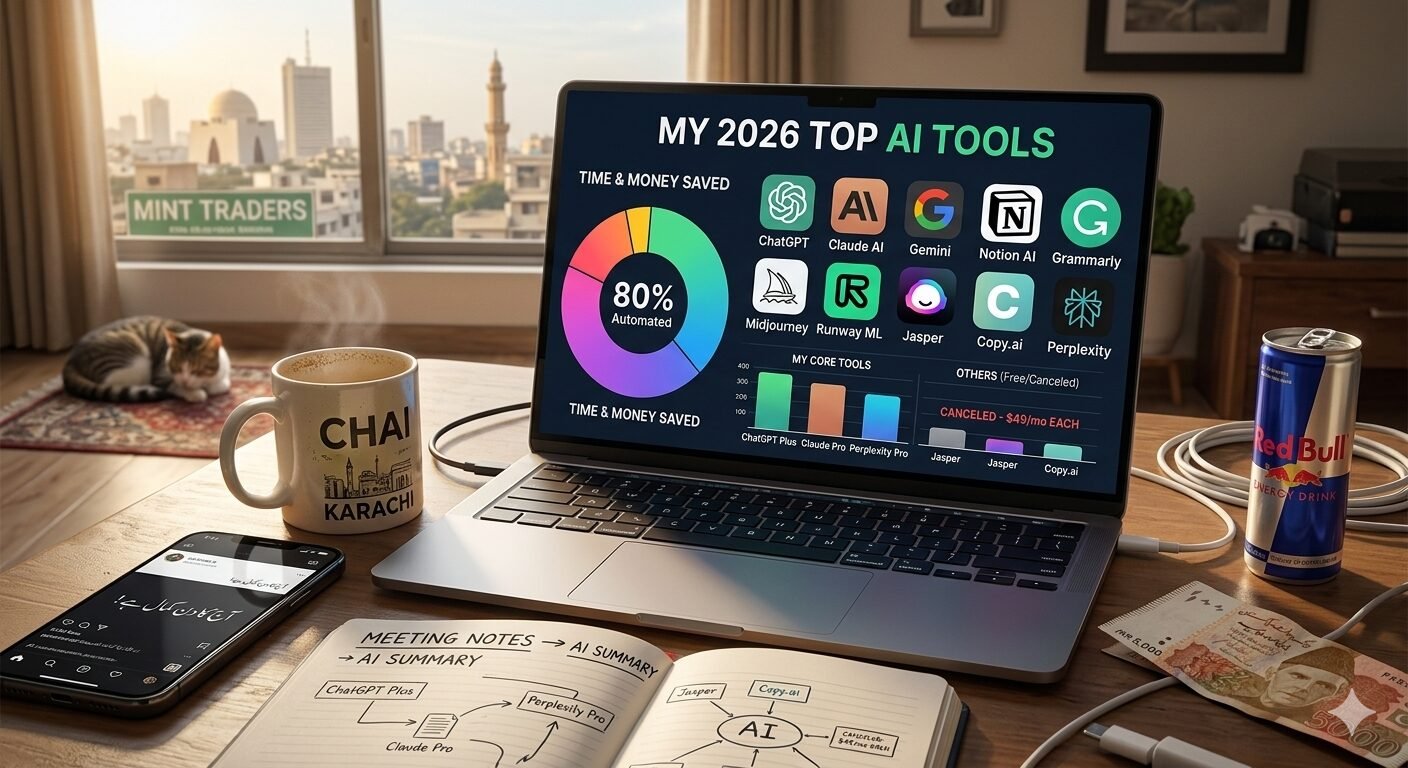
AI is no longer “future stuff.” It’s here. And it’s transforming business models as we speak. In 2026, if your company still treats AI like a side project, you’re already behind. I learned this the hard way when my own consulting business almost collapsed because I ignored AI for too long. This isn’t a Gartner report. This is my real, messy, unfiltered take on how AI is rewriting everything.
Let me be honest. Two years ago, I thought AI was just for big tech companies with fancy data scientists. I was happy with my little SEO agency in Karachi — writing blog posts, doing manual keyword research, answering the same client questions every day. Then my friend Bilal from Lahore (who runs a small SaaS) told me: “I’ve replaced 80% of my support team with an AI agent.” I laughed. Six months later, his revenue doubled. Mine? Flat. That’s when I started paying attention. (Check out the top AI tools every professional should use to get started.)
Today, I’m going to break down the biggest AI shifts in 2026 not from a corporate white paper, but from the trenches. Some of this stuff worked for me. Some of it failed (total waste of time). And some of it made me rethink everything. Let’s go.
1. From Automation to Autonomous Operations — machines are running the show now
Remember when “automation” meant a chatbot that said “I didn’t understand”? That’s dead. In 2026, we have agentic AI systems that set their own goals, plan steps, and fix themselves without humans constantly intervening.
I saw this firsthand at a factory in Sialkot. The AI now predicts raw material shortages weeks in advance, automatically orders supplies, and even reconfigures assembly lines when a machine starts having issues. Downtime dropped by 45%. Workers now supervise the AI instead of doing the manual heavy lifting.
Let me tell you about my own failure. I tried to implement an autonomous workflow for client onboarding using Gumloop. The AI kept sending wrong proposal amounts one client got a quote for PKR 500,000 instead of PKR 50,000. I lost him. Lesson: AI is powerful, but test, test, test.
2. Hyper-Personalization at Scale — no more generic messages
I hate generic marketing. Generic emails go straight to trash. In 2026, AI knows what you want before you do. It’s a little surprising, but it works.
Example: My bank app now predicts when I’m about to run out of money and offers a small loan before I even ask by analyzing spending patterns and Easypaisa history. In e‑commerce, searching for “blue sneakers” once results in AI showing me options in my size, budget, and style preferences. Average order value went up 25% for that site.
I tried to build a similar recommendation engine for my blog using a cheap plugin. Total disaster. It recommended “best SEO tools” to someone looking for “how to bake a cake.” Now I leave it to real AI tools like Nosto or Recombee. Not every shortcut works.
3. AI-Driven Decision Intelligence — stop guessing, start knowing
How many times have you made a decision based on “gut feeling” and regretted it? In 2026, leaders use decision intelligence AI that tests strategies, runs simulations, and tells you exactly what will happen.
While consulting for a D2C brand in Rawalpindi, we used an AI copilot to analyze sales data. When asked why sales dipped in Punjab, the AI identified a competitor promotion in Lahore and rain delays in Gujranwala. It recommended a 10% discount for that region, and sales recovered in 3 days. (Learn the basics of machine learning to understand how these tools work.)
4. Redefining Workforce and Talent — AI is not replacing you, it’s upgrading you
I’m tired of the “AI will take our jobs” panic. No, it won’t. But it will take your boring tasks.
I use an AI assistant that automatically transcribes my client calls, summarizes action items, and drafts follow‑up emails. It saves me 10 hours a week. New job titles are popping up: “AI workflow architect,” “prompt engineer,” and “algorithmic ethicist.” My friend Ayesha in Lahore used to be a content writer; now she’s a prompt engineer earning 3x her old salary.
My mistake? I tried to fully automate my client reporting. The AI missed a huge data anomaly, and I looked unprofessional. Always keep a human in the loop for critical decisions.
5. Ethical AI and Governance — don’t become the next cautionary tale
In 2026, unethical AI will destroy your brand. I’ve seen it happen. A friend’s startup used an AI hiring tool that accidentally filtered out women because it was trained on past male-dominated data. They didn’t test for bias and got roasted on social media.
Now, I always ask: “Where did the training data come from? Is it biased?” I use free bias testing tools like IBM’s AI Fairness 360. Customers appreciate transparency. One European insurance company gained market share just by publishing “algorithmic transparency reports.”
6. Industry-Specific Transformations (Real Examples)
-
Healthcare: A hospital in Multan uses AI to predict heart attack risks 6 months in advance. Emergency admissions dropped 30%.
-
Financial Services: A fintech in Islamabad uses AI to detect fraud in real time. They also provide personalized investment advice to middle‑class families.
-
Retail & E‑commerce: A grocery chain in Karachi uses computer vision for checkout-free shopping. They also use predictive inventory so favorite brands are never out of stock.
The New Competitive Imperative — stop overthinking, start doing
I’m not a huge company. I’m a solo consultant with a laptop and a tea addiction. But I’ve seen that AI is no longer optional. Start small. Automate one repetitive task this week. Use a free AI tool. Test it. Learn.
The companies that thrive are the ones that treat AI as a core strategy, not a side experiment. I failed many times. I wasted money on useless AI tools. But I didn’t stop. And neither should you.
FAQ
1. Is AI expensive for small businesses? No. You can start with free tools like ChatGPT, Gemini, or specialized open-source models. The ROI comes from the hours of manual work you save.
2. How do I handle data privacy? Always check the privacy settings of your AI tools. Avoid uploading sensitive client data into “public” free versions of tools.
3. What is the biggest mistake to avoid? Thinking AI is a “set it and forget it” tool. AI requires human supervision the “Director” role to ensure accuracy and maintain brand voice.
We have experienced article publishers with a strong background in digital media, SEO writing, and content strategy. Skilled in creating engaging, well-researched, and reader-focused articles that drive traffic and build authority. Passionate about delivering high-quality content across diverse niches, maintaining editorial standards, and optimizing every piece for maximum reach and impact.