
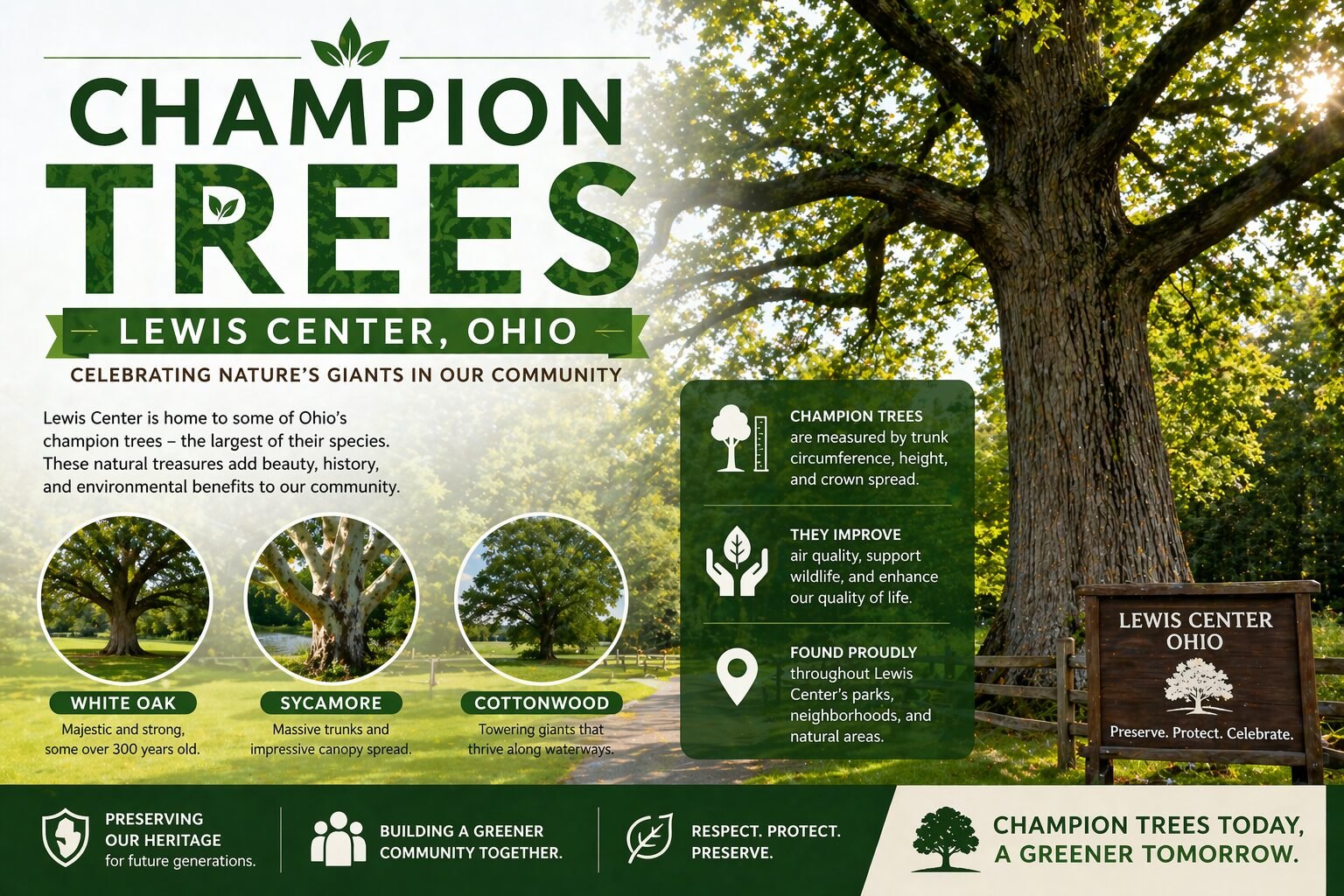
Champion trees near Lewis Center Ohio are the largest documented specimens of their species in the state — recognized officially by the Ohio Department of Natural Resources through the Ohio Champion Tree Program. Found across Delaware County’s parks, private land, and school grounds, these ancient trees have survived centuries of development and climate change. If you live near Lewis Center and haven’t gone looking for them yet, you’re missing something genuinely impressive.
Quick Facts About Champion Trees Near Lewis Center Ohio
Here’s a fast overview of everything you need to know before you start exploring.
| Detail | Information |
|---|---|
| Location | Lewis Center, Delaware County, Ohio |
| Governing Program | Ohio Champion Tree Program (ODNR) |
| Measurement Criteria | Height + Circumference + Crown Spread |
| Common Species in Area | White Oak, Bur Oak, Silver Maple, American Sycamore, Tulip Tree |
| Who Can Nominate | Any member of the public |
| Trees Found On | Public parks, school grounds, private property |
| Soil Type | Fertile glacial soils — ideal for deep root systems |
| Nearby Waterway | Olentangy River — feeds the ecosystem that supports these trees |
| Legal Obligations for Owners | None — recognition only, no mandatory preservation rules |
What Champion Trees Actually Are
Champion trees are the largest recorded specimens of a specific tree species within a defined geographic area — in this case, Ohio.
The Ohio Department of Natural Resources runs the Ohio Champion Tree Program, which tracks and officially designates these trees across the state. To earn champion status, a tree must be measured using a three-part formula: height (in feet) + circumference at breast height (in inches) + one-quarter of the average crown spread (in feet). The tree with the highest combined score for its species earns the title.
This isn’t just a size competition. Champion trees represent living records — proof that a particular species reached its maximum known potential in a specific landscape. They also serve a real ecological function. These oversized trees produce more seeds, support more wildlife, and store more carbon than younger, smaller trees of the same species. They are, in practical terms, the most valuable trees in any forest or landscape they occupy.
Anyone can nominate a tree. You don’t need to be a professional arborist or a government official. If you spot a tree near Lewis Center that seems unusually large, you have every right to measure it and submit a nomination to the ODNR.
Why Lewis Center Ohio Produces Champion Trees
Lewis Center sits in Delaware County — and the geography of that region directly explains why champion trees grow there.
Thousands of years ago, glaciers covered this part of Ohio. When they retreated, they left behind deep, mineral-rich soil that remains some of the most fertile in the state. That soil creates ideal conditions for large, deep-rooted tree species. Combined with access to the Olentangy River and its surrounding wetlands, the Lewis Center area provides the moisture, nutrients, and stability that trees need to grow exceptionally large over centuries.
Before European settlement, this entire region was dense, old-growth forest. As farmland replaced forest and then suburban development replaced farmland, most of those ancient trees disappeared. But some survived — on private estates, along old fence lines, in corners of parks, and on school grounds. Those survivors kept growing. And several of them are now the largest of their kind in Ohio.
That combination of glacial soil, water access, and long-term survival through development cycles is what makes Delaware County — and Lewis Center specifically — a productive area for finding champion trees.
People also love to read this: Pravi Celer: The True Celery With Benefits You Never Knew About
The Champion Tree Species You’ll Find Near Lewis Center
Five tree species dominate the champion tree listings in and around Lewis Center. Each one thrives in Delaware County’s specific landscape conditions.
The Five Species to Know
| Species | Key Characteristics | Why It Thrives Here |
|---|---|---|
| White Oak | Massive trunk, broad canopy, long-lived | Thrives in deep glacial soils, common throughout Ohio |
| Bur Oak | Extremely thick bark, fire-resistant, 200+ year lifespan | Adapts well to varied soil types in Delaware County |
| Silver Maple | Fast-growing, prefers low-lying wet areas | Common along Olentangy River flood zones |
| American Sycamore | Distinctive white bark, huge canopy, damp soil lover | Found near streams and wetlands throughout the county |
| Tulip Tree | Straight, tall trunk — can exceed 100 feet in height | Rapid grower in nutrient-rich glacial soil |
White Oak trees are arguably the most impressive champions in the area. Their trunks can reach circumferences of 15 feet or more on the largest specimens. They grow slowly but consistently for hundreds of years, which is why the oldest examples reach record-breaking sizes.
Bur Oak trees stand out for their survival capability. Their thick, deeply ridged bark protected them from the fires that historically cleared other tree species from Ohio’s landscape. Many surviving Bur Oaks in Delaware County are over 150 years old.
American Sycamores near Lewis Center tend to grow along creek banks and wetland edges. Their white upper bark makes them easy to spot — and their sheer size, with some canopies spreading 70 to 80 feet across, makes them unmistakable once you’re looking.
How the Champion Tree Nomination Process Works
Nominating a champion tree is a straightforward process that any resident near Lewis Center can start.
You begin by measuring the tree using three data points: trunk circumference at 4.5 feet above the ground, total height in feet, and average crown spread. You calculate the total points using the formula: circumference (inches) + height (feet) + (crown spread in feet ÷ 4).
Once you have the measurements, you contact the Ohio Department of Natural Resources to submit your nomination. If the tree is on private property — which many champion trees are — you’ll need the landowner’s permission before measuring. The ODNR reviews the submission against existing records for that species. If your tree scores higher than the current champion, it earns the title.
The ODNR does not impose any legal obligations on landowners whose trees earn champion status. There are no mandatory preservation requirements, no restrictions on property use, and no financial penalties if the tree is later damaged or removed. Recognition is the only outcome — but for many landowners, that recognition carries real personal and community meaning.
Where to Look for Champion Trees Near Lewis Center
Finding champion trees near Lewis Center takes patience and some deliberate looking — these trees aren’t marked with tourist signs.
Public parks in Delaware County offer the most accessible starting points. Alum Creek State Park, just east of Lewis Center, has significant stands of old-growth adjacent woodland. Highbanks Metro Park along the Olentangy River corridor contains some of the county’s oldest trees in protected natural areas.
School grounds in the Lewis Center area — particularly those on property that was farmland before suburban development — often have old fence-line trees or woodlot remnants that include large, old specimens. These trees were frequently left standing when fields were cleared because they marked property boundaries.
Private property holds many of the region’s most impressive specimens. If you’re driving through older residential areas in Delaware County and spot a tree with an unusually thick trunk towering above the surrounding canopy, it’s worth noting the location. “Big tree hunters” — the informal community of people who actively seek and nominate champion trees — often reach out to landowners directly when they spot a potential candidate.
Why Champion Trees Near Lewis Center Matter for the Community
Champion trees are not just environmental records — they’re community anchors with real ecological value.
A single mature White Oak supports over 500 species of caterpillars alone — more than almost any other North American tree. Those caterpillars feed birds, which feed larger predators. The tree’s acorns feed deer, squirrels, turkeys, and dozens of other species. Its canopy shades waterways, keeping them cool enough for fish. Its roots hold soil in place and filter groundwater.
A champion tree does all of that at maximum scale. The biggest White Oak in Delaware County produces more acorns, supports more wildlife, and filters more water than any younger, smaller oak nearby. Losing it to development or disease creates a gap in local ecology that takes 100 to 200 years to fill.
For residents of Lewis Center specifically, these trees also represent the pre-suburban landscape of Delaware County — a physical connection to what this land looked like before the subdivisions, highways, and commercial developments arrived. They’re history you can measure with a tape.
People also love to read this: Ksözcü: Turkey’s Boldest Newspaper That Refuses to Stay Quiet
Lesser-Known Facts About Champion Trees Near Lewis Center
- Ohio maintains a separate register for both state champion trees and national champion trees — some Ohio specimens hold both titles simultaneously.
- The ODNR’s champion tree database is publicly searchable, listing the GPS coordinates of many documented champions — giving you a real starting point for finding them yourself.
- Delaware County’s glacial soil depth in some areas exceeds 200 feet — providing root systems with essentially unlimited downward growing space, which contributes directly to the exceptional size of the trees that grow here.
- Some champion trees in Ohio have been documented and measured for over 50 consecutive years, showing steady growth even at ages well past 150 years.
- The American Sycamore has the largest trunk diameter of any native North American hardwood — with some Ohio specimens exceeding 11 feet in diameter at breast height.
- Young trees growing in the shade of champion trees often show significantly stronger growth rates than those in open ground — the champion tree’s deep root network improves soil structure for surrounding vegetation.
Final Thoughts
Champion trees near Lewis Center Ohio are one of the area’s most overlooked natural resources. They’ve been growing since before Delaware County was a county. They survived the conversion from forest to farmland and from farmland to suburb. And they’re still standing — bigger than anything nearby, ecologically irreplaceable, and open for anyone motivated enough to go find them. Start with the public parks, keep your eyes on unusually wide trunks, and if you think you’ve found something significant, get out a tape measure. You might be looking at Ohio’s next official champion.
FAQs
What is a champion tree and how does Ohio define one?
A champion tree is the largest known specimen of a particular species within Ohio, designated through the Ohio Department of Natural Resources Champion Tree Program. Trees earn the title based on a combined measurement score: trunk circumference in inches + height in feet + one-quarter of the average crown spread in feet. The highest-scoring tree for each species holds the champion title.
Where can you find champion trees near Lewis Center Ohio?
Champion trees near Lewis Center are found in Delaware County’s public parks — including Alum Creek State Park and Highbanks Metro Park — as well as on school grounds and private property throughout the area. The ODNR’s champion tree database includes GPS coordinates for many documented specimens, giving you a searchable starting point for your search.
Can anyone nominate a champion tree in Ohio?
Yes. Any member of the public can nominate a tree for champion status in Ohio. You measure the tree’s height, trunk circumference, and crown spread, calculate the combined score using the ODNR formula, and submit the nomination to the Ohio Department of Natural Resources. If the tree is on private land, you need the landowner’s permission before measuring.
Why does Lewis Center Ohio have so many large trees?
Lewis Center sits in Delaware County, which has exceptionally deep, fertile glacial soil — the legacy of glaciers that retreated thousands of years ago. That soil provides ideal conditions for large root systems. Combined with proximity to the Olentangy River and its wetlands, the area supports tree species that grow to exceptional sizes over centuries. Some of the county’s largest trees have been growing since before European settlement.
Do champion tree owners have legal obligations to preserve their trees?
No. The Ohio Champion Tree Program offers recognition only — it does not impose any legal preservation requirements on landowners. Owners of champion trees are not obligated to maintain, protect, or preserve their trees under state law. The designation is honorary. Many landowners choose to protect their trees voluntarily once they understand the significance of what they have, but there are no penalties if they do not.

We have experienced article publishers with a strong background in digital media, SEO writing, and content strategy. Skilled in creating engaging, well-researched, and reader-focused articles that drive traffic and build authority. Passionate about delivering high-quality content across diverse niches, maintaining editorial standards, and optimizing every piece for maximum reach and impact.